Restoring Hair Naturally: What to Expect From an FUE Hair Transplant London
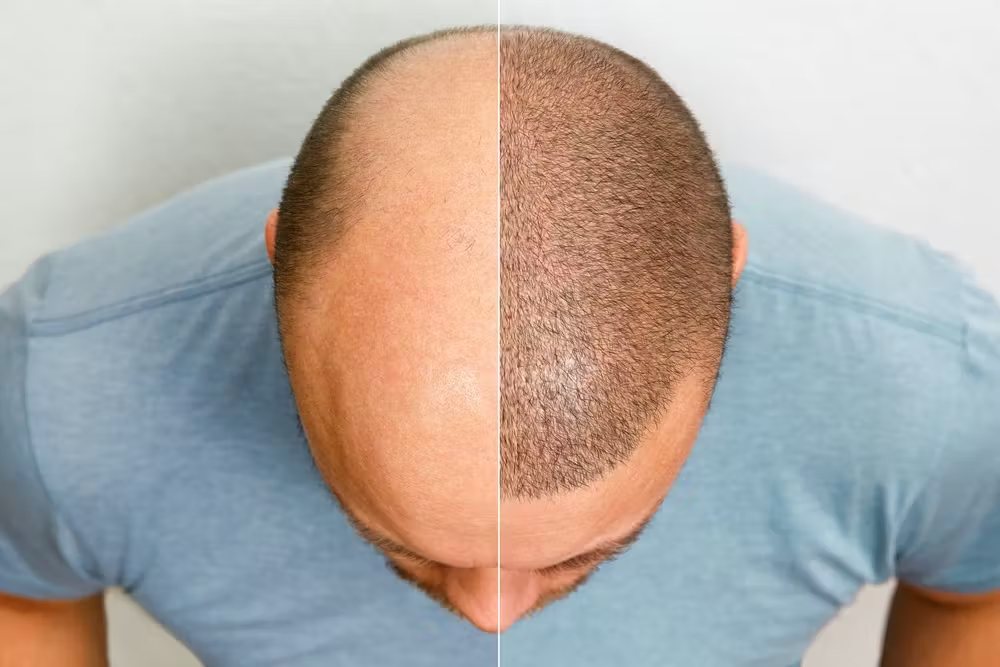
Hair loss is a condition that affects millions of men and women worldwide. Thinning hair can have a substantial effect on an individual’s self-esteem and visual confidence, regardless of whether it is caused by genetic predispositions, hormonal fluctuations, stress, or natural ageing. Cosmetic hair restoration has evolved from basic surgical interventions to highly refined, microscopic procedures as a result of medical advancements over the years. Follicular Unit Extraction (FUE), a technique that is widely recognised as a prominent method for permanent hair restoration, is one of these modern solutions. Due to the region’s concentration of highly competent clinical practitioners and cutting-edge medical standardisation, individuals who are interested in top-tier aesthetic procedures often investigate the option of a FUE hair transplant London.
In order to comprehend the mechanics of a FUE hair transplant London voyage, it is necessary to examine the natural growth of follicular units on the human scalp. The hair does not typically emerge as individual, isolated strands; rather, it grows in small, naturally occurring groupings known as follicular units, which contain anywhere from one to four hair follicles. Follicular Unit Extraction is based on the fundamental principle of harvesting these individual groupings directly from a healthy donor site on the patient’s head and meticulously transplanting them into areas that are experiencing thinning or complete hair loss. The FUE hair transplant London procedure is particularly appealing to modern patients who require effective results with manageable downtime due to the minimal scarring and relatively expeditious recovery that patients experience, as it avoids large linear incisions.
The Diagnostic Assessment and Initial Consultation
The process of hair restoration commences prior to the removal of any surgical instrument. Every successful FUE hair transplant London treatment plan is founded on a thorough evaluation. A specialised clinician executes a comprehensive analysis of the individual’s scalp during this initial phase, evaluating the density and overall health of the donor area, which is typically situated at the back and sides of the head. These regions are genetically predisposed to resist the effects of dihydrotestosterone, the hormone that is primarily responsible for androgenetic alopecia or male pattern baldness.
The clinical team meticulously maintains the long-term integrity of the donor region while calculating the specific graft count necessary to accomplish the patient’s desired density during this diagnostic evaluation. The donor zone may exhibit visible thinning as a result of overharvesting; therefore, precise mathematical mapping is imperative. The visual density that can be achieved through a FUE hair transplant London intervention is influenced by the scalp’s elasticity, hair calibre, curl pattern, and contrast between hair and skin tone, all of which are evaluated by the clinician. Additionally, this consultation establishes realistic expectations to guarantee that the hairline is tailored to the patient’s facial structure and age progression in a natural manner.
Preparing for the Surgical Procedure
Meticulous preparation guarantees optimal graft survival rates and patient comfort following the finalisation of the treatment plan and the arrival of the surgical date. The patient participates in a final consultation to evaluate the proposed hairline design on the morning of the procedure. The recipient area is meticulously delineated by the practitioner using surgical markers, and the contour is adjusted to align with the natural growth directions and facial proportions.
The patient’s hair is typically shaved to a short length of approximately one to two millimetres in the donor region or across the entire scalp, depending on the desired number of grafts. Shaving enables the surgical team to plainly observe the direction, angle, and density of individual hair units. The cranium is meticulously disinfected with antiseptic solutions following the shaving process. Subsequently, local anaesthesia is administered to both the donor and recipient zones to guarantee that the patient is completely pain-free and pleasant during the entire FUE hair transplant London procedure. Additionally, patients may be provided with gentle sedation options to facilitate relaxation during the extended clinical session.
The Phase of Graft Harvesting and Extraction
Extraordinary surgical precision, manual dexterity, and patience are required during the extraction phase, which is a delicate process. The practitioner creates a minute circular incision in the skin surrounding each individual follicular unit using a specialised micro-punch tool, which typically has a diameter of 0.7 to 1.0 millimetres. The punch’s depth is meticulously adjusted to sever the tissue connections in the vicinity without causing damage to the delicate underlying follicle root, a condition known as graft transection.
The clinical team employs ultra-fine forceps to gently extract the individual follicular unit from the donor bed after the micro-incision has been completed. The grafts that are extracted are immediately inserted into a specialised chilled saline or nutrient-rich storage solution. It is imperative to preserve the body’s optimal temperature, hydration, and biochemical equilibrium during this out-of-body experience, as exposed hair follicles are highly susceptible to cellular stress and desiccation. An FUE hair transplant London clinician guarantees the highest possible level of viable survivability for each harvested graft by adhering to stringent quality control during the extraction process.
Graft Processing, Quality Control, and Recipient Site Creation
Dedicated surgical technicians conduct a high-powered microscopic examination of each harvested follicular unit while graft extraction is in progress. The quantity of individual hairs contained within each unit is a critical factor in the meticulous sorting of grafts, which are classified as single-hair, two-hair, or multi-hair-grafts. Single-hair follicles are meticulously reserved for the leading edge of the hairline to achieve a soft, natural aesthetic, while multi-hair units are categorised for insertion behind the front line to provide structural volume and maximum optical density.
Concurrently, the primary clinician initiates the process of preparing the recipient area by establishing micro-incisions, which are frequently referred to as recipient sites. Tiny incisions are created in the thinning areas of the scalp by employing specialised needles or custom-sized micro-blades. Arguably, the most artistically challenging aspect of a FUE hair transplant London procedure is the development of these sites. In order to replicate the natural growth pattern of the surrounding area, the practitioner must meticulously regulate the depth, angle, direction, and spatial density of each incision. Proper angle alignment guarantees that the new hair grows in a natural, flat manner against the cranium, rather than in an awkward direction.
The Phase of Implantation
The implantation phase commences after the recipient locations have been meticulously prepared. The surgical team inserts individual follicular units into the recipient slits using specialised pen-style implanter devices or micro-forceps. To guarantee that the grafts are seated at the appropriate depth, this phase necessitates an extraordinary amount of concentration. Placing a graft too deep can result in cosmetic irregularities or skin pitting, while placing it too superficial can result in graft displacement or poor vascular integration.
The patient is able to remain at ease during the implantation phase by either resting or watching entertainment while the surgical team performs the procedure. The entire process typically requires six to eight hours due to the fact that an extensive session may involve the transplantation of several thousand grafts. Graft hydration levels and cellular health are meticulously monitored during this period to guarantee that the grafts are in a state of high vitality upon final placement.
Recovery and Healing Following Surgery
The transition into the recovery phase, which is essential for achieving long-term results, is marked by the conclusion of the surgical procedure. Small red micro-scabs develop around each extracted donor site and newly implanted recipient slit immediately following a FUE hair transplant London treatment. The donor sites heal swiftly without the need for sutures or the presence of linear surgical scars due to the minuscule size of the micro-punches used in extraction.
Patients are advised to maintain a slight elevation of their heads during the initial forty-eight hours in order to alleviate localised swelling, which occasionally descends toward the brow and eye region. Specialist washing protocols are delineated in the postoperative instructions to ensure the scalp remains clean and to prevent the accidental dislodgment of fragile new grafts. The recipient area is maintained hydrated during the initial stages of healing through the use of soft spray administrations of sterile saline solution.
Natural sloughing of the small surface scabs occurs within seven to ten days, disclosing the healthy, pink underlying skin under gentle washing habits. The majority of patients are able to resume desk-based work and routine social interactions within a week to ten days of their FUE hair transplant London session, provided that they refrain from engaging in strenuous physical activity and direct sunlight exposure during the initial recovery weeks.
Comprehending Long-Term Maintenance and Results
When undergoing hair restoration, it is essential to exercise patience, as the visible results are achieved gradually over the course of several months. Patients typically observe that transplanted hair shafts begin to discharge approximately two to four weeks following the procedure. Medically referred to as telogen effluvium or shock loss, this is an entirely typical physiological reaction to the trauma of harvesting and relocation. The living hair follicle roots are securely incorporated beneath the scalp surface, where they are in a dormant phase.
The third or fourth month following the procedure is the typical time for new hair growth to commence. The emerging strands may initially appear fine and delicate; however, they gradually thicken, gain pigmentation, and strengthen over time. The final density, texture, and natural appearance are attained between twelve and eighteen months, with significant aesthetic improvement becoming visible between six and nine months. The restored growth is permanent, providing a long-term solution for individuals who opt for a FUE hair transplant London path to restore their hairline, confidence, and natural appearance, as the transplanted hair is sourced from hormone-resistant donor zones.